

To run a safe and efficient warehouse, a welding business, metalworking school, or at-home workspace requires having the proper ventilation. The most dangerous aspects of metal fabrication include internal damages caused by the inhalation of toxins. If you’re looking to protect the well-being of yourself and others, here’s a guide on the different source capture options for weld fume extraction.
Key Takeaways
-
Source capture pulls weld fume at the arc, before it reaches the welder’s breathing zone, which is why it works as a primary control rather than a supplement.
-
The International Agency for Research on Cancer classified welding fume as a Group 1 human carcinogen in 2017, and OSHA caps hexavalent chromium at 5 micrograms per cubic meter of air over an 8-hour shift.
-
Extraction arms, portable and wall mount extractors, and downdraft tables cover most manual welding and grinding stations.
-
A central fume extraction system can serve an entire plant, but ducting and operational costs often run into the tens of thousands of dollars.
-
Capturing weld fumes well depends more on arm position and filter maintenance than on headline CFM.
Get the Right Setup for Your Shop
Fume Dog manufactures source capture equipment in Rome, Georgia, and sells direct: 1,200 CFM portable extractors, wall mount units, downdraft tables, and extraction arms built for real welding positions instead of a catalog photo. Call 1-800-980-3481, use the Welding Lab Designer if you are laying out a training shop, or browse the full lineup at fumedog.com to match a system to your shop floor.
What Makes Weld Fume Dangerous
Weld fume is not smoke. The arc vaporizes the base metal, the filler, and whatever coating sits on the surface, and that vapor condenses into particles fine enough to reach deep lung tissue. The same process releases gases including ozone, nitrogen oxides, and carbon monoxide.
In 2017 the International Agency for Research on Cancer moved welding fume from a possible carcinogen to a Group 1 carcinogen, meaning the evidence in humans is sufficient. The most dangerous fumes usually come from what is on the metal rather than the metal itself. Stainless and chrome alloys produce hexavalent chromium, which OSHA limits to 5 micrograms per cubic meter of air as an 8-hour average. Galvanized coatings release zinc oxide. Old paint and primer can release lead. Because these airborne contaminants spread through the shop atmosphere in seconds, welders are not the only ones at risk, and other workers who never touch a welding torch still carry the exposure. More detail on the specific compounds is in our guide to what is in common welding fumes.
Natural Solutions
“Natural solutions” really means using the air available to you as an easy way to remove toxins. These tactics work best for smaller workshops, like garages or small businesses, and should only be used to supplement other, more comprehensive methods and machinery.
That being said, don’t underestimate the suction benefits of opening doors and windows while welding. For garages, keeping that large door open throughout the day ensures clean breathing air and fewer fumes. Windows in a tiny warehouse adequately extract weld fumes, especially when paired with a quality HVAC system.
OSHA draws a clear line here. Under 29 CFR 1910.252(c), natural ventilation is acceptable only when each welder has more than 10,000 cubic feet of space, ceilings reach at least 16 feet, and nothing blocks cross ventilation. Below that, a mechanical ventilation system is required at a minimum of 2,000 CFM per welder unless local exhaust hoods or booths are in place. Dilution also treats air quality as an average, so the air at the arc stays the dirtiest air in the building, and open doors stop being an option in January. These traditional methods are a supplement, not a solution. Our breakdown of OSHA welding ventilation requirements covers the rest of the standard.
Extractor Machines
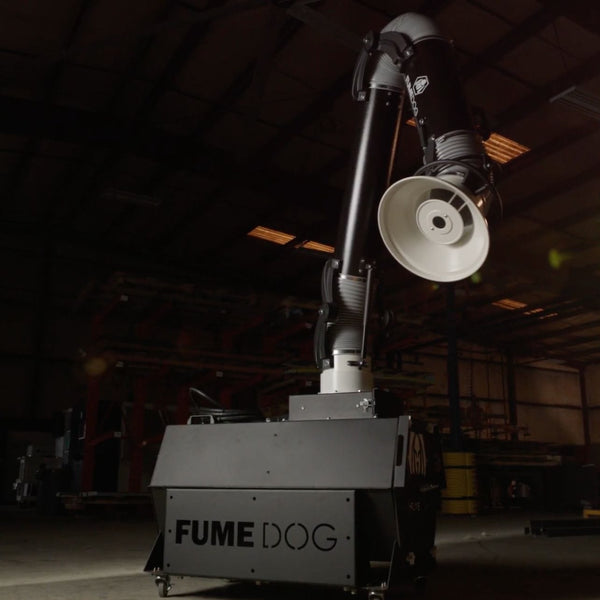
For more extensive areas, you must invest in quality extractor machinery that automates the recycling process. These devices are built solely to clean toxins from the air and operate effectively, ensuring employees are safe. FumeDog offers sturdy varieties of extractors that are perfect for any workspace.
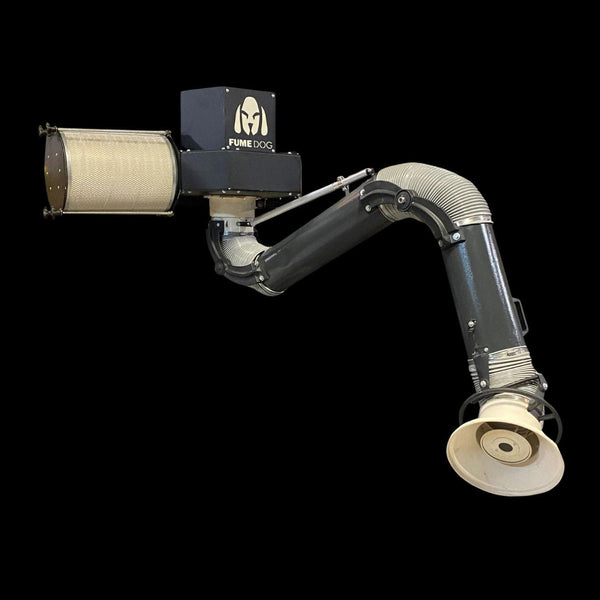
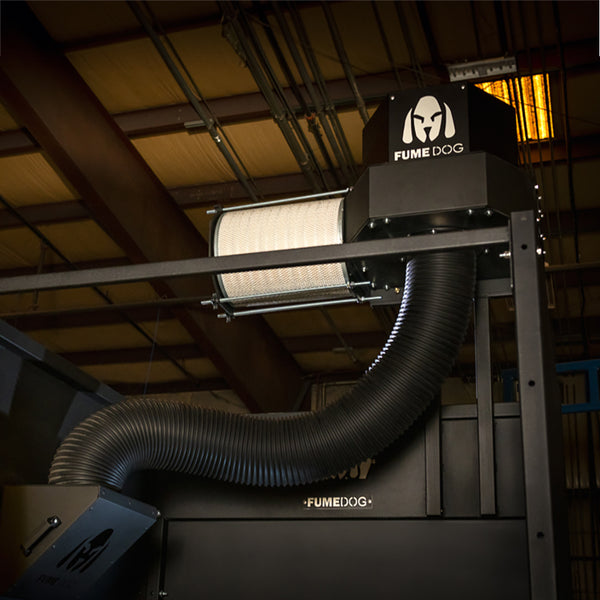
Our portable fume extractors allow for more flexibility in the warehouse, while our wall-mounted devices keep air clean and floors clear of obstacles. Paired with the proper arm attachment, these machines are among your best defense against overexposure to weld fumes.
The numbers behind that: every Fume Dog portable and wall mount unit moves 1,200 CFM through a MERV 15 fire-retardant nanofiber filter on a 1.5 HP motor running on standard 120V single-phase power. No three-phase drop and no compressed air line, so a unit can be installed in an afternoon. An Air Stream Filter Cleaner extends filter life roughly five to six times over reverse-pulse designs, which is where most of the long-run cost of fume extraction actually sits.
Extraction Arms
Airflow matters only at the point of capture. Fume capture falls off sharply with distance, so the arm has to follow the work: parked 6 to 12 inches from the arc, a 6- or 8-inch arm will extract fumes before they rise past the helmet. Fume Dog arms hold a 360-degree range of motion with external joints and an internal damper, so a welder can reposition without stopping. Standard steel-and-aluminum arms come in 7, 10, and 14 foot reaches, with lighter economy and magnetic arms suitable for benches and temporary setups. This is the right approach for manual welding, where the joint moves around the part all day.
Downdraft Tables
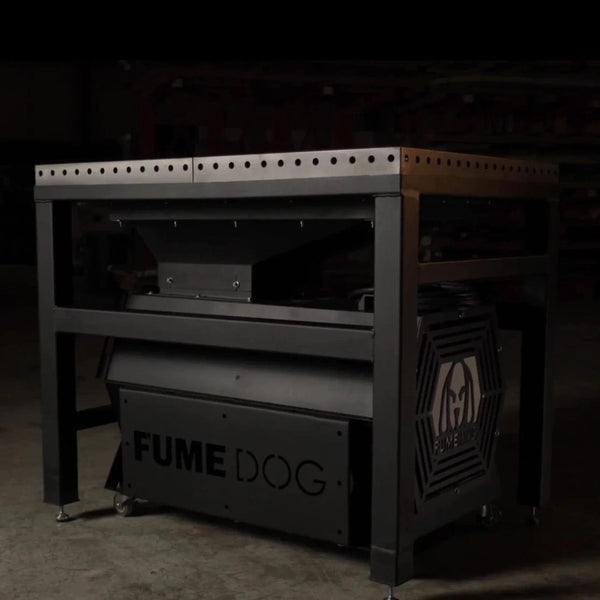
The easiest way to weld without exposing oneself to high metal fumes is to work on a downdraft welding table. These machine marvels have built-in extractors that utilize downdraft physics to clean air as your work constantly.
Much like our other extractor products, our downdraft equipment is guaranteed to keep employees healthy and productive. The Fume Dog table pulls 400 FPM across a 36 by 42 inch acorn surface, with spark traps and baffles ahead of the same MERV 15 nanofiber filter, so it handles grinding dust as well as stick, MIG, and TIG work. That matters in metal fabrication shops, where grinding often puts more dust into the air by weight than the welding does.
Source Capture Systems vs a Central Fume Extraction System
A central fume extraction system ducts every station in the facility back to one large collector sized for the entire plant. On paper it is tidy. In practice the ductwork is the expensive part: engineering, hangers, balancing dampers, roof penetrations, and a make-up air unit to replace the extracted air being pushed outside. Installed cost for a mid-size shop commonly reaches the tens of thousands of dollars before the first weld, and operational costs continue because one oversized fan runs whether two stations are busy or twenty.
Standalone source capture systems invert that math. Each unit plugs into a 120V outlet and draws power only at the stations in use. Fume Dog list prices run from about $4,250 for a wall mount exhaust unit to about $6,400 for a downdraft table, so a shop can add one station at a time as production volume grows instead of committing to a plant-wide design up front. Central systems still earn their keep where fume generation is high across fixed, permanent welding positions. For most job shops they are more complicated than the problem requires.
Robotic Welding Cells
Robotic welding changes the geometry of the problem. A robot welds at a far higher duty cycle than a person, so fume generation per hour climbs, but nobody is standing in the arc. An arm at the torch becomes impractical because the cell needs the clearance and the joint never stops moving.
Robotic welding cells are normally handled with a hood over the cell that catches fume as it rises, ducted to a collector sized for the cell’s output. Where the cell is open or shares floor space with hand stations, an ambient unit such as the Fume Dog Industrial Air Cleaner adds a second layer of filtration for the air the cell releases. Ambient equipment supplements source capture, it does not replace it, as our comparison of ambient vs source capture explains.
Comparing Fume Extraction Solutions
Five factors decide the method for most welding applications:
-
Where the arc is. Fixed bench work makes a downdraft table or wall mount unit suitable, while work that moves calls for a portable extractor.
-
Duty cycle and production volume. One to two shifts a day is the design point for Fume Dog equipment.
-
The welding process and the base metal. Flux-cored and stick on coated or stainless stock produce far more fume per hour than gas-shielded TIG on clean mild steel.
-
Filter access. This is the critical long-run cost, and standard-size filters beat proprietary cartridges every time.
-
Available power. 120V single-phase equipment avoids bringing in an electrician.
One caution on spec sheets: most manufacturers publish CFM at the fan, not at the hood, so real-world performance depends on arm length, bends, and filter loading. Fume Dog posts performance videos of the equipment capturing fume on live welds, which is a more honest comparison than a rating alone.
Maintenance and Long-Term Performance
A fume extractor loses capture as the filter loads, and the loss is invisible from behind the hood. Maintain a short routine: check airflow at the arm weekly, empty the spark trap on a downdraft table, and keep the internal damper set where you left it. Fume Dog units carry a ten-year limited warranty against defects and use standard replacement filters, so maintenance stays a stocked part rather than a service call. Nothing about the operation is difficult, and skipping it is what turns good equipment into shop decoration. See our fume extraction maintenance guide for the full schedule.
There’s a wide range of different source capture options for weld fume extraction that you can implement into your welding workspace. The right one puts capture as close to the arc as your work allows. Luckily, Fume Dog offers superior fume extraction equipment for all your needs.
Frequently Asked Questions
What is source capture welding fume extraction?
It is any method that removes weld fume at or near the arc, before it enters the welder’s breathing zone. Extraction arms, downdraft tables, and fume hoods all qualify. Dilution ventilation and ambient air cleaners do not, because they treat fume only after it has spread through the room.
How close does an extraction arm need to be?
As a working rule, 6 to 12 inches from the arc, repositioned every time the weld moves. Capture velocity falls off very quickly with distance, so an arm parked three feet away is doing almost nothing for the welder.
Does OSHA require a welding fume extractor?
OSHA does not name a product. It requires that exposures stay under the permissible exposure limits and, under 29 CFR 1910.252(c), that mechanical ventilation be provided when a welder has less than 10,000 cubic feet of space, ceilings are under 16 feet, or partitions block cross ventilation. Source capture is the usual way shops meet that.
Do I need a central fume extraction system?
Only if you have many fixed stations running constantly and the budget for ducting plus a make-up air unit. Most shops get the same protection from standalone units at a fraction of the installed cost, and they can expand one station at a time.
Can one extractor serve two welding stations?
Not at the same time. A 1,200 CFM unit with a single arm is sized for one active arc. Splitting that airflow across two arms cuts capture velocity at both, which defeats the point of source capture.
How often should fume extractor filters be replaced?
There is no fixed interval. It depends on the welding process, the materials, and hours run, so watch airflow at the arm rather than the calendar. The Fume Dog Air Stream Filter Cleaner is designed to stretch filter life five to six times over reverse-pulse cleaning, and the replacement filters are a standard size.
Does source capture work for robotic welding?
Not at the torch. Robotic welding cells are better served by an enclosure or hood over the cell, ducted to a collector, with ambient filtration as backup for whatever escapes into the plant.
Will a fume extractor pull away my shielding gas?
It can if the arm sits too close or points straight at the weld pool. Keep it at the distances above and slightly off-axis, and use the internal damper to trim airflow. That is enough to protect the shield on most MIG and TIG work while still capturing the fume.